


TEA 4000
The Portable Polarographic / Voltammetric System
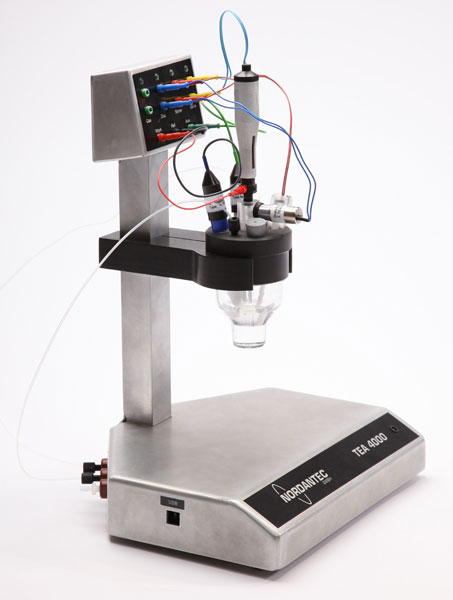
The system includes our hanging mercury drop electrode (HMDE) which enables trace analysis with extremely low detection limits. The mercury consumption using the HMDE is not more than approx. 1 – 2 ml per year. Alternatively the system can be fitted with solid state electrodes as glassy carbon, gold, platinum and silver.
The TEA 4000 includes a user friendly software with powerful measurement and calculation tools. The polarographic stand is completely controlled by the software. All important measurement techniques are available on the TEA 4000.
- Differential-Puls-Polarography
- Differential-Puls-Stripping-Polarography
- DC Polarography
- Anodic and Cathodic Stripping Voltammetry
- Cyclic Voltammetry
- Cyclic Voltammetric Stripping
Prominent Features
- Compact, minimum space requirements.
- Compatible with any commercial PC or notebook.
- Software for control and calculation
- All typical voltammetric/polarographic analysis methods available.
- Hanging Mercury Drop Electrode with low Hg-consumption.
- Solid-state electrodes (glassy carbon, gold, platinum and silver).
- Low price
- Can be used without expensive inert gases
- Very easy to use
- Very low detection limits
- Easy sample preparation and short analysis time
- Simultaneous detection of more than one element
- Portable system for outdoor analysis
System Equipment
The basic equipment of the TEA 4000 includes the electronic stand, the electrodes, the software and all accessories required for laboratory analysis. Power is provided by a 12 V DC power supply, connection to the computer is via USB.Optional accessories
We provide different standard kits which includes standard solutions and other chemicals as buffers, chelating agents etc. For mains independent measurements we provide a rechargeable battery pack.TEA 4000 Field Case
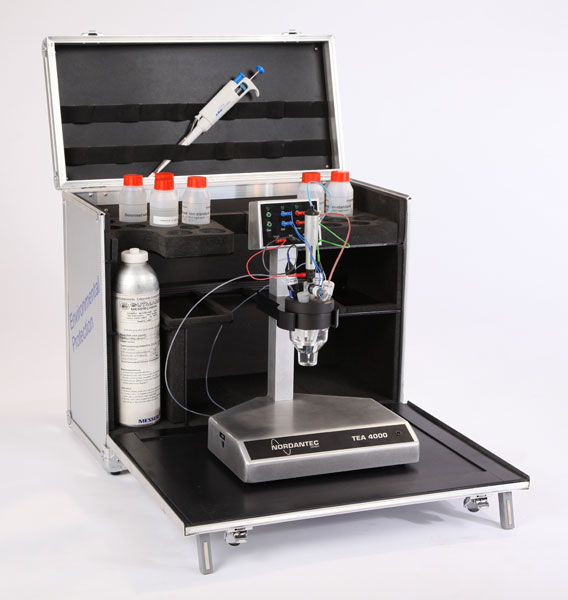
Fields of application of TEA 4000
The polarography/voltammetry is one of the most important analytical techniques in the fields of environmental protection, mineralogy, metallurgy, geology and in the chemical industry. Fields of application are:- Environmental analysis of natural waters and soils.
- Waste water and process water monitoring in chemical industry.
- Purity analysis in galvanic and electronic industry.
- Tribodiagnostics of motor oils and other lubricants.
- Trace analysis in pharmacy, biochemistry and food control.
Cations
Anions
Sulfide, Sulfite and Thiosulfate, Chloride and Bromide, Nitrate, Nitrite, Cyanide, Phosphate
Organic Compounds
Vitamin C in fruit juice, Vitamin B2, Vitamin B9, Nicotinamides, Cystine and Cysteine, Oil in Water, PCB/TCB, Pesticides, Aldehydes
| Specifications: | |||||||||||||
| Width | 27 cm | ||||||||||||
| Height | 35 cm | ||||||||||||
| Depth | 22 cm | ||||||||||||
| Weight | 3 kg | ||||||||||||
| Control | USB | ||||||||||||
| Power Supply | 12 V DC | ||||||||||||
| Working electrodes | HMDE, Glassy Carbon, Gold, Platinum, Silver | ||||||||||||
| Auxiliary electrodes | Platinum | ||||||||||||
| Reference electrodes | Ag/AgCl, Hg/Hg2Cl2, Hg/HgSO4 | ||||||||||||
| Potential range | +- 2.5 V | ||||||||||||
| Scan speed | DC, CV up to 1 V/s at 10 mV/point, DP up to 66 mV/s at 10 mV /point | ||||||||||||
| Current range | 10 nA FS – 2 mA FS | ||||||||||||
| Minimum current | 0,1 nA | ||||||||||||
| Methods |
|
| Selection of Detection limits: | |||
| Cd | 0.05 ppb | Cu | 0.05 ppb |
| Cr | 0.01 ppb | Hg | 0.03 ppb |
| Ni | 0.01 ppb | Zn | 0.05 ppb |
| Pb | 0.05 ppb | Co | 0.01 ppb |
| As | 0.1 ppb | Mn | 0.5 ppb |
| Se | 1 ppb | TI | 0.03 ppb |
| Fe | 30 ppb | NO3- | 50 ppb |
| NO2- | 10 ppb | NH4+ | 60 ppm |
| CI- | 1 ppb | SO42- | 20 ppb |
| PO43- | 20 ppm | S2- | 10 ppb |
